


Page 56 - spielbox 4_24 Englisch E-Paper
P. 56
At a Glance. Geht noch was?
A Canny Yahtzee Core
By EDWIN RUSCHITZKA
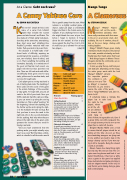
The objective is to fulfill tasks of dif- ferent levels of difficulty, requiring an ascending number sequence, a minimum sum, two-of-a-kind, three-of-a-kind, and so on. That is anything but exciting and innovative; basically, it is reminiscent of the good old Yahtzee. Each round, one player rolls the four blue and three red dice. There are 96 task cards with differ- ent difficulty levels: green ones for easy tasks, yellow ones for medium tasks, and red ones for tough tasks.
Each player gets a scoring track and a set of starting task cards. The handling of these cards over the course of the game is the actual challenge of the essential- ly easy game. To begin with, you put all cards to the left of your track. Once you fulfill a task and mark the card according- ly, you can move it up along the scoring track later on. This is called “pushing.” At the beginning, it doesn’t do anything, but the further up the card is lying, the high- er is the multiplier for later scorings. But first, you have to move the cards to the right side—this is the second alternative for the pushing. And only when they are lying on the right side do the green cards generate the income that you need for buying new tasks.
Once you have understood how the pushing works, you might actually enjoy Geht noch was? But that takes a while, which is a hurdle for all those who would
like to gamble away from the start. What remains is a slightly cerebral game of chance. Lady Luck plays a considerably bigger role than in the Clever series, for example. If you challenge her too much, she might thumb her nose at you. And before I forget to mention it: Forget about the solo variant! Is it fun to play alone against the dice? No, it isn’t. A lit- tle malicious joy is allowed—for at least
“K
lein & fein” (Small & Fine) is the name of a series from Schmidt
Spiele that includes the Clever games and also Encore! and Dizzle. The dice make all of them pretty luck-depen- dent but, at the same time, entertaining. Now, Geht noch was? (Anything Else Possible?) provides venturers with new fodder. Push-your-luck in its purest form.
two players ...
(sbw)
     Mango Tango
A Clamorous
By STEPHAN ZERLIK
Mango? TANGO! Players cheer, call out the words—
sometimes jubilantly, other times sadly, sometimes with their arms
in the air or an all-round check. And suddenly, like out of nowhere, they all slap on the poor mango chutney, with roaring laughter.
Mango? TANGO! Players groan, totally overstrained by the situation; they stare at their cards, mumble reluctantly, and inde- finably wave their hands above their head.
Both things happen in Mango Tango. The game divides the community—you ei- ther love it or hate it.
In turn, you play the top card from your own draw pile. Depending on the image, the entire group reacts with the loud “Mango? TANGO!” call and
the respective gesture.
The confusion is com-
plete as soon as a “Tan-
go Mango” is revealed.
From then on, you need to
reverse the order of the words,
first to “Tango? MANGO!,” and, later on, back. Got it?
If somebody makes a mistake, this player has to take back
the cards he has
played, where-
as all the oth-
ers are allowed
to discard the
cards lying in
front of them. An agreeable rule. Even if a group brims over with energy and fun, it’s enough at some point. As soon as one player has no cards left, he wins.
Designer Markus Müller uses a trick to ensure that all players should be at- tentive all the time: As soon as three mood-matching mangoes are lying next to one another, you need to slap on the mango chutney card as if you were try- ing to kill a mosquito. Being the slowest counts as a mistake.
Mango Tango does many things right, but only very few ones are new. The con- cepts seem long known and kind of out- dated. Nevertheless, it has been a while since a game in this genre has applied these mechanisms and game principles in such an elegant manner. In the end, it’s only the fun you’re having during a game that counts anyway.
  Photos: Becker, EMF-Verlag, Jumbo, Ruschitzka, Schmidt Spiele, Zerlik
Title: Designer: Illustration:
Publisher: Players: Age: Duration: Price:
Geht noch was? Jens Merkl
Marco Armbruster, Hendrik Noack Schmidt Spiele
1– 4
about 8+ years about 30+ minutes about 15 euros
 Reviewer
Edwin Ruschitzka
Stefan Ducksch
Playing appeal
6
7
The extensive and, at first sight, not very intuitive rules overcast a tricky scoring sprint over no more than five rounds. From the second game, it’s good. Moderate materials.
Manuel Fritsch 7
Gambling and a high risk of different dice-rolling results. Great fun. Despite the extremely high luck factor, you get the feeling of being in control.
Christoph Schlewinski 6
It can be very punishing, but also very thrilling. The mechanism stays in your brain, but it takes a round before it sinks in. If nothing works, you’ll be left out in the cold.
Harald Schrapers 7
A nice dice-rolling game with a natu- rally high luck factor. Relatively many rules, which is liked better by frequent players than by occasional players.
Stephan Zerlik 6
If you fail to generate income in time and also have too much bad luck,
you’ll have no chance but to lag behind.
Fabian Ziehe 7
A dice-rolling game with a lot of influence and tactical options. Nice, emotional moments thanks to the push-your-luck element. However, a pretty rule-heavy game design.
 54   spielbox


