


Page 50 - spielbox 4_24 Englisch E-Paper
P. 50
 48
spielbox
Review. Pick a Pen: Crypts / Gardens / Reefs
Is It a Pen? Is It a Dice?
It Is Both!
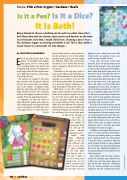
Being allowed to choose something can be quite an ordeal. How often I wish there were only two starters, main courses and desserts on the menu in a restaurant. Even then, I would still be torn. Choosing a pen in Pick a Pen, however, triggers an exciting overwhelm in me. This is why I prefer a round of pens to a restaurant. It’s also cheaper ...
By CHRISTOPH SCHLEWINSKI
Even if you buy all three Pick a Pen games, it’s probably still cheaper than going out for a fancy meal
once, including drinks and dessert and everything. And you’ll be entertained for much longer. After all, there are three lev- els of difficulty in the Pick a Pen series. So you have options.
All versions are played in the same way: someone rolls the pencil, everyone chooses one (or more than one depend- ing on the number of players), enters what the pencil says and then the next player throws the pencil. This continues until an end-of-game condition has been reached. Points are awarded at the end.
In Gardens, you have the choice of either filling the garden plots with one color or having each color appear at least once in the garden bed. With five colors in the game, this is of course only possi-
ble for
the plots that are five or more squares in size. As you have to color in the number specified by the pencil, you soon realize the difficulty. That’s why colorful plots are worth a lot of points. But first you have to manage to mark each color once in each plot.
But that’s not the only way to win. It is also worth filling many beds with one color. At the same time, it is worth distrib- uting all colors evenly or to be the first to fill all the border fields. Or, alternative- ly, to have the largest, contiguous color area. Or simply to be the first to finish.
With Reefs, on the other hand, you want to paint long lines to reach treasure fields. In this scenario, however, the pen- cils don’t just let you paint, they specify how you can paint: either just a straight line or any number of bends. Five colors make up to five different lines (submers- ibles), which you can use and which may intersect but may not use the same route. You also have a lot to choose from: quick-
ly bag all the treasures of one color? Or collect the col- ors evenly? Or would you prefer to pick up the coins scattered
along the routes? Crypts work quite differently again, as you see five different sym- bols on your piece of paper, arranged in five rows, which you have to color in from left to right. If the color of the pencil matches the color of a symbol, you get a bonus move. Points are award- ed if the same colors are
adjacent in the columns and rows. And bonus points are awarded if you score points in every row and column.
In the other two levels of the three scenarios, there are changes that are not huge, but big enough to give each game a new and interesting twist. Personally, I didn’t think that would really work. You know how it goes: they add some extra to say there’s more content for the money, but it’s rarely that great. But when I did try out the other levels, I was impressed. Like I said, there’s not much that’s been changed, but it’s got a kick. It’s really cre- ative how they’ve worked this. You don’t have to completely change any of the lev- els. What you’ve just learned remains the same and is merely expanded. Each time I thought to myself, ‘Oh look, that’s funny. How tricky, let’s do another round.‘
The Pick a Pens have therefore quickly become the most popular roll & write in my game groups. It is one of the very few representatives of the genre where every- one really wanted to try out all three lev- els and was impressed by each one. Some players liked Gardens best, some Reefs, others Crypts, but no matter what the preference, each of the titles were liked and played over and over again.
In addition to the quick start, the pen- cils are of course also part of the appeal. They are eye-catching and by no means just a stupid gimmick. The only problem is that you have to remember what the pencil showed AFTER you have grabbed it. So it’s best to say out loud what it says. And since this apparently happened a lot during testing, it’s even written in the rules. Very good.
Reiner Knizia may not have reinvent- ed the roll and write genre with his Pick a Pen series, but these three games are still special and should be considered. They are easily accessible and quickly explained, but still challenge the brain
Fotos: 999 Games, Amigo, Becker


