


Page 41 - spielbox 4_24 Englisch E-Paper
P. 41
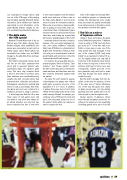
  Photos: Bruce Whitehill
ous, especially for foreign visitors. Only one out of the 270 pages of this catalog was in English, partially filled with behav- ioral advice. Each exhibitor also had the opportunity to post information on the Game Market website. Helpful for visi- tors—provided they understand Japanese.
I The dojin make
the TGM special
Between 70 and 80 percent of the ex-
hibitors were from Japan. Among them, besides Arclight, other established com- panies were represented as well, such as Hobby Japan, Japon Brand (which has meanwhile been taken over by CMON, Singapore, though), Oink, Itten, and Saas- hi & Saashi.
But what’s particularly special about this fair are the dojin: amateurs—from school girls to seasoned “gamers”—who significantly shape the Japanese game scene. This time, they occupied about a third of all booths (in previous years, there had been even considerably more), usually only with one table where they presented their self-made and self-pub- lished games, sometimes in a print-&-play version or just as a prototype. And often, the games were not even contained in a sturdy box, but just in a bag or envelope.
It often happened that the 50 or even fewer copies of such games were sold out within a very short time. Many do- jin attract attention not only from Jap- anese companies but also or even more
so from representatives from the western world; more and more of these come to the Tokyo Game Market or send out local scouts to search for innovative creations. Where else do you have so many possibil- ities of getting to know fresh, often un- conventional ideas of independent game inventors whom you would never meet at other fairs, and picking up a game that will never be available again in this form?
Interested visitors from other countries, however, often encounter language bar- riers, since many exhibitors, especially dojin, have difficulties to communicate in English. But everybody is willing to help or to refer you to somebody who is able to speak English, and somehow or other, the communication will work anyway.
For instance, the young dojin who pre- sented her games “Beef or Chicken,” “Star Collector,” and “Flower Garden” under the label J’s Box was able to tell that her name was Alisa and that these were her first creations, developed together with her partner.
The name “No Luck” stands for a group of pen-&-paper role players who offered small game accessories at prices of the equivalent of 3 to 6 euros. In addition to games, there were more of such items offered for the hobby; at the booth of the small company Tokiquil, for example, you could pay a fee of 500 yen (3 euros) and try to solve the puzzle printed on one of the puzzle T-shirts within ten minutes in order to acquire the shirt.
Some of the smaller booths had differ- ent exhibitors present on Saturday and Sunday. The Saturday was more sought after, since there are usually considerably more visitors present on this day to whom the amateurs can show their games.
I The fair as a mirror
of Japanese culture
Unlike in Essen and Cannes, the gates
to the TGM didn’t open before 11 AM and closed as early as 5 PM. And only those got access at 11 o’clock who had an ex- hibitor or press pass or were one of the lucky people who had managed to buy one of the coveted 2,500 “early entry tickets” at an equivalent of about 18 eu- ros. The regular tickets cost only half as much; but on the downside, these visitors had to wait in long lines in front of the entrance, didn’t get in before noon and, consequently, couldn’t get hold of the best gimmicks early—and had to make their way through the aisles amidst a crowd of people.
But this didn’t derogate from the dis- cipline. In the lines—for instance, in front of the sales area of Yellow Submarine, one of the very few game store chains in Japan—people were not only waiting patiently, but even politely left room for other people to pass through the aisle.
Special aspects of Japanese culture were reflected everywhere at the fair. For instance, the tendency to turn everything (including games) into a piece of art. But
spielbox   39


