


Page 39 - spielbox 4_24 Englisch E-Paper
P. 39
   Title: Designer:
Illustration: Publisher: Players: Age: Duration: Price:
Shake that City Mads Fløe,
Kåre Torndahl Kjær Olga Kim
AEG
1– 4
about 10+ years about 20 – 40 minutes about 35 euros
 Reviewer
Stefan Ducksch
Udo Bartsch
Playing appeal
7
6
The shaker works surprisingly well.
Andreas Becker 6
Very lean rules. Building with what is shaken out in front of you to score points is, again, a tile-laying master- class in the best sense of the word.
  Review. Shake that City
Cool Shaker
By STEFAN DUCKSCH
The last time I came across some- thing similar was in 2014: a card- board construction with rubber bands from which material falls out when pressed. At the time, a gimmick like this was enough for Camel Up to beat the
wonderful Splendor in the battle for Spiel des Jahres. There is something
similar in the placement game Shake that City. But this time, it’s definitely not
a gimmick!
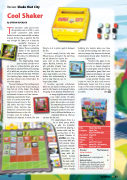
The bright yellow shaker
spits out nine colorful wood- en cubes in a three-by-three grid when the slider is pressed. These are buildings, all of which we can place as tiles of one color on our personal city map. However, the starting player always chooses first and their chosen color is then taboo for
the other players.
The next challenge: The buildings must
be placed on your own board exactly as they fell out of the shaker. The display may not be rotated or mirrored. This is unfortunate because we have various planning requirements: Shops
score a lot more points when
they are placed closer to the
city center, but only if roads
lead to them. Factories also
need to be connected to roads. Residential houses, on the oth-
er hand, count for nothing if
factories are adjacent to them. The best
thing to do is to plant a park in between the two.
It sounds simple, but we only have fifteen moves. At least in the last three we are allowed to choose the
same color as the starting
player. By then, however, we will probably already have arranged our plan in such a way that the required color cubes may tumble out of the shaker, but unfortunately in such a way that we can no longer place them.
It becomes especially unfortunate when we can build something but don’t want to. We have to do it anyway! Simply foregoing is not allowed. And then hous-
es merge together and suddenly score fewer points. It’s quite tricky and a fun and fast-paced game. We can also score points
by completing bonus score tiles around the edge of the board. They give points for four iden- tical or different buildings or a completely filled row. Then we
can turn the tile over.
For casual players, there is a
lot to think about, which is why the publisher recommends playing a variant with only the scoring tiles on the outside. Readers of spielbox can, how- ever, start with the full version. Once you have a handle on it there is an alternative city map with dif- ferent scoring conditions on the back. Addi- tionally, there is an optional, rather sneaky
building site module where you have to clear all the building sites before you can score any points. Anyone who knows my hometown knows why I think this is
a great idea.
Therefore the game in the
colorful box with the cool shak- er is by no means a beginner or party game, but an original optimization game that even experienced players can enjoy as a snack or nightcap. There is also another module called
Lights of the City and a solo version. Additionally, Shake that City is clearly foolproof. The writer of these lines has as- sembled the shaker himself without any accidents. (dm)
spielbox 37
     Photos: Alderac Entertainment Group, Becker, Ducksch


