


Page 44 - spielbox 4_24 Englisch E-Paper
P. 44
Review. La Marche du Crabe
Crustaceans with a Handica
By SYBILLE WHITEHILL
with, each player gets two of the twelve item cards and keeps them face down in front of him. Each of these cards depicts something that is lying on the beach or floating in the sea. The beach display also shows all items, and this is where you want to move the crabs token in or- der to free the trapped crab buddies. But you should do your best to avoid the four forbidden objects. Otherwise, you will encounter an enemy there and, as a dis- traction, need to feed him shrimp, five of which are initially available.
In addition, there is an enemy appear- ing on the beach at the beginning of each turn—either a vicious big brown crab or a sly lobster—that has to be placed in the depicted beach zone. This way, the baddies spread out over the course of the game; to crawl over them, you need to bribe them with a shrimp.
But how can you find out, without any talking, which forbidden items the oth- er player has? In the early stage of the game, you might boldly move the crabs token onto a beach card with the image of any object—after all, you still have the full number of shrimps and can af- ford to sacrifice the first two, if need be. But from the (optional) movement of the crabs token and also from the placement of the enemy cards, the other player can soon try to deduce what items he should probably head for or avoid on his next turn.
The players win if they free eight crabs. If they don’t manage to achieve this
before all enemy cards have been used up, they lose—as they do if they would need to give up more shrimp than they have left. Either way, the game is over after about fifteen minutes. Often, you will want to play another game straight away—also since the changing forbidden objects and different set-ups of the beach make La Marche du Crabe quite vari- able. And when experienced crab players think they have exhausted the possibili- ties of the standard game, they can try out a campaign with the ten successive adventure cards that provide increasingly difficult beach conditions.
What makes this deduction game spe- cial is not only the fitting graphic design but also the unusual theme with its very well-done integration into the mecha- nisms.
T
which the animals have the handicap of only being able to walk in one direction. This specification was so appealing to designer Julien Prothière that he decided to use it for a game. de Pins took on the graphic design of La Marche du Crabe (The March of the Crabs), and in keeping with this style, the instructions were writ- ten in a casual and witty manner.
As in Prothière’s earlier game of Roméo & Juliette, La Marche du Crabe is also a game for two players who are limited in their communication: Since crustaceans can’t speak, the players are not allowed to verbally communicate either; instead, they have to give clues to each other sole- ly through their actions.
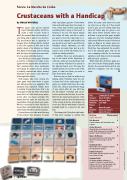
Both players take turns moving the same game token that shows a square crab taking another one piggyback. This illustrates that teamwork enables them to actually change directions—that is, by one player moving the token horizontally across the 6-x-6-card beach area, where- as the other one moves vertically. This means that the crabs are restricted, but nevertheless, they can reach every space. Which is necessary for their objective to rescue their crab buddies that are buried under items littered by careless humans.
Freeing these poor crabs would be easy if there weren’t two obstacles: To begin
he square crab species inspired French illustrator Arthur de Pins to
create a series of comic books in
    Title: Designer: Illustration: Publisher: Players: Age: Duration: Price:
La Marche du Crabe Julien Prothière Arthur de Pins
Jeux Opla
2
about 8+ years about 15 minutes about 13 euros
 Reviewer
Sybille Whitehill
Udo Bartsch
Playing appeal
7
6
Crab movement well transferred into a game.
Stefan Ducksch 6
Thematically unusual and visually pretty. With some practice, the playing quality is kind of limited, though.
Maren Hoffmann 5
An original idea, but other than that, there’s not much going on at the beach.
Stephan Kessler 6
Reasonable. The campaign increases the replayability appeal.
Harald Schrapers 5
Nice theme, but not equally convinc- ing in terms of play.
Stephan Zerlik 5
No matter whether sideways or forwards: The basic concept excites players only for a short time and, after winning one game, hardly entices them to go back to the beach.
Photos: Becker, Huch, Jeux Opla, Whitehill
 p
 42   spielbox


