


Page 33 - spielbox 4_24 Englisch E-Paper
P. 33
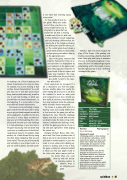
   ine making a set of four hedgehogs (one shared characteristic). You may also have, for example, four acorns showing in that set (two shared characteristics). You could also have one of each fruit (acorn, black- berry, hazelnut, and mushroom), as well as one of each leaf showing, in which case you will have one shared characteristic, i.e. the hedgehog. It is not possible to have more than two shared characteristics.
The Glade is not a particularly complex game, but the first few turns will be tricky as you get your head wrapped around the above explanation. In addition to this rule, you must, of course, figure out where to play your set. In the beginning, this is sim- plicity itself; but then your real challenge is to take advantage of your sets later in the game by placing new sets down that re-use one or possibly more of the tiles al- ready placed. Can you, for example, make another set of dark brown tiles by using the dark brown hedgehog that you put down earlier? Tiles are placed horizontally and vertically on your player board in a grid not unlike Scrabble, but with anoth-
er nice twist that enclosing spaces score points.
So how exactly do you use the glade? When you make a set of three, you place one
of your toadstools face up on the glade in a space that rep-
resents the tile that is missing
to make a set of four. So, with a set
of three different colored hedgehogs,
and each showing a different fruit, the missing tile is the hedgehog showing the missing fruit and the missing col-
or. The central glade board shows a grid in which all tiles are represented, and you place your toadstool face up
in the appropriate spot.
Later in the game, someone may
draw the missing tile. If they do so and spot that it is highlighted by your toadstool on the glade board,
then they may place that tile on your board if there is space and take your toadstool. The toad-
stool still scores for you, but it is
also worth 1 point to the oppo- nent who took it.
Points earned can be increased: if a tile is returned to you from the Glade, because another player has exactly the same missing tile you had in a set, then the toadstool is worth an extra point and is placed in your store. Should you later build an enclosure, then that toad- stool may be placed inside the enclosure, which is worth a further extra point.
The Glade is a game with a bit of a learning curve, but usually within three or four turns into the game, you will un- derstand the rules. Then the challenge begins: how best to work with the tiles you draw to make the best scoring combi- nations. I really like the challenge of this, and find the game goes fast as I focus on my next turn right after I finish playing the current one.
Designer Richard Breese likes inter- action and The Glade provides some of that as you try to spot missing tiles and add them to another player’s or your own board to score extra points. Making en- closures is exciting, and on top of that, the game contains an advanced variant in which you flip your player board to the other side, where spaces yield ex-
tra points when you cover them up with the indicat- ed matching symbol. In addition, there is an intriguing solo
Overall, I have very much enjoyed my plays of The Glade. I like puzzling over my tiles, overcoming a bad tile draw with some clever play, and trying to maximize my score as the game progresses. Some- times I fail, but it is always intriguing and entertaining, and for this length of game, has the right amount of luck. I definitely recommend the game.
    Title: Designer: Illustration: Publisher: Players: Age: Duration: Price:
The Glade
Richard Breese
Vicki Dalton
R&D Games
1– 4
about 14+ years about 30 – 60 minutes about 50 euros
 Reviewer
Simon Weinberg
Christwart Conrad
Playing appeal
7
6
Challenging puzzles or brain training to find the best combinations. A little long with four players, so that a coop- erative style of play often developed. Unfortunately, the acquisition of tiles is completely determined by chance.
Edwin Ruschitzka –
I would have liked to score, but the language and structure at least of the German rulebook are so bad that I didn’t even begin to understand it after reading it several times. And
I didn’t want to take the time to painstakingly work through the whole thing. Very poor editorial work, this is definitely not how a game should be launched on the market!
 game.
spielbox   31


