


Page 32 - spielbox 4_24 Englisch E-Paper
P. 32
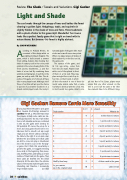
 Review. The Glade / Tweaks and Variations. Gigi Gacker Light and Shade
The sun breaks through the canopy of trees and bathes the forest clearing in golden light. Hedgehogs, toads, and squirrels sit slightly hidden in the shade of trees and ferns. Three toadstools add a splash of color to this green idyll. Wonderful. The Glade looks like a perfect family game that is right on trend with its nature theme. But beware: this forest is highly abstract.
By SIMON WEINBERG
According to Richard Breese, he conceived of this design while on a walking holiday in England. The game, which is built around a summer forest setting, features tiles showing four kinds of creature, each in four colors, with symbols in the corner showing fruits of the forest (acorns, blackberries, ...) and four kinds of a tree leaf. By combining these symbols and having two of each tile in the game, we end up with 128 tiles. The ob- jective of the game is to form sets of these tiles on your player board. Making a set of three or four tiles will win you the chance to put one of your twelve toadstools on a shared central player board—the nicely il-
lustrated glade of the game title. Toad- stools can be worth one or two points. When one player places all twelve of their toadstools, or the tiles run out, the game ends.
The essence of the game, and
its 14+ age rating, comes from
how sets are made. Players start
with a set of tiles placed in front
of them on a tile rack. They may
place a single tile or a set of up to
four tiles on their board, in which
all their tiles match in one of three ele- ments: same animal, same fruit, or same leaf (that is identical with the color). This, in itself, would be a game, albeit a sim-
ple one. But in The Glade, players must ensure that one other element on the tiles in a set is all the same or the other two elements have to be different. Imag-
  Gigi Gacker: Remove Cards More Smoothly
If you play Robert Brouwer’s card game Gigi Gacker (Zoch-Verlag; reviewed in spielbox #3/24, p. 54) with fewer than five players, initially some cards are ran- domly put back into the box. If all mother hens or all valuable worms are contained in this set, the game won’t develop its full potential. Of course, the set-up for a short and crisp game should not be too laborious; but to smooth out any rough edges, you can remove cards according to the table to the right. It is not quite clear whether the uncertainty as to what cards are still to come into play is intentional, since this doesn’t occur in the five-play- er game. But I think this uncertainty is good for the game, so I suggest removing more cards in the beginning than neces- sary, shuffling these, and taking a certain number of them back into the game. Then these cards are shuffled into the initial draw pile. At the same time, the extreme values of the worms make the game more interesting, and therefore, I increasingly forgo medium values. (cc/sbw)
Total number 9
5
5
5
5
4
4
4
4
Shuffle, then keep:
2 or 3 4 4 2
1 0
2 1
3 2
4 2
3 2
2 1
1 1
1 0
3 2 9
players
1-point worm to remove 2-point worm(s) to remove 3-point worms to remove 4-point worms to remove 5-point worms to remove 6-point worm(s) to remove 7-point worm to remove 8-point worm to remove of these cards in the game
                  Photos: Becker, R&D Games , Zoch-Verlag
     So, you remove
(as in the original rules):
   18
  30
spielbox
What to do mother hens to remove
cards in total


