


Page 24 - spielbox 4_24 Englisch E-Paper
P. 24
  22
spielbox
Review. Planta Nubo
Trees Do Not Grow
Into the Sky
You almost don’t dare write it again: but the world as we know
it has come to an end. Thorsten Hanson wrote it much more atmospheric in “Planta Nubo” (the short story) from “Planta
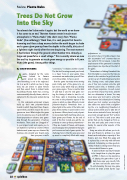
Nubo” (the anthology): “Back then, it is said, people first heard a humming and then a deep murmur before the earth began to shake and a green glow grew up from the depths in the stuffy, dirty air of a lightless night shortly after the new beginning. The next moment it had broken through the ground: Arbor Number One. Already as large and powerful as a small village.” This is exactly where we now live and try to generate as much green energy as possible in Planta Nubo (the game). Among other things.
polyominoes or
you cannot place it: luckily, players may also accumulate “soil” counters that are very useful to fill out spaces. I enjoy this puzzle aspect of the game and it certainly gives players one objective at the start of the game.
The mechanic of taking flowerbed tiles from the table is a neat one: the tiles are placed on the outside of a grid, but in the center is a set of randomly placed action tiles. During a turn, each player places one of four tool counters onto the grid between action tiles, or between a tile and a flower polyomino. In each round, you use three of your four tools, and the last one determines a bonus. You may never place your tool next to a tile that has someone else’s identical tool. Having placed your tool counter, you may then take either one action from a neighbor- ing tile or a neighboring flowerbed. A special action allows you to take two of these actions instead of once, but only if you stored enough special “bot” actions to do so. This robot is used as an extra worker that can be charged up from ac- tion tiles and cards, and comes in very handy for several other aspects of the game too.
Using an action tile allows you to de- liver your flowers to airships on a main board: each airship has a capacity of four flowers, and once filled, flies away and is replaced by a new ship with different demands. Fortunately, you have good vis-
ibility of what is coming next to help you choose which flowers to grow.
It turns out that I was very fortunate to be taught how to play the game at SPIEL in Essen, so my experience of playing the game when I got it back home was very smooth. Oth- ers have not had the same bene- fit—unfortunately, this very nice game has been let down a little by the orga-
By SIMON WEINBERG
Agame, designed by the same team behind La Granja and joined by the brilliant Uwe Rosenberg, is not to be neglected. Set in a world in which we live in huge trees, we are driven to plant flowers and then export them to distant lands by airships, Planta Nubo has a strong, environmentally-friendly theme, which is explained in the rules and evoked during play.
In this solarpunk evironment players build up their own polyomino-based boards in which they plant these flowers, export them, and then recycle the soil to grow more trees. What singles the game out is its extensive use of cards with dif- ferent properties to enhance your game- play through the generation of various mechanics. These cards are “plugged in” to your player board and require you to use batteries or power-up counters. These batteries and power ups are obtained by moving a die around your board; every
time you pass a card’s
“connection,” it obtains another counter. The die itself, moving around your board, is a major focus in your game; these movements are made when you sell flow- ers to the airships. So far, so good.
But the game has many more moving parts. Firstly, part of the game is to ob- tain more cards, which help you develop your game engine. There is another kind of card that is used for end game scor- ing; the timing of when to start to col- lect these cards is interesting. Secondly, we come to the polyomino aspect of the game, in which you take different-colored polyomino-shaped flowerbeds from a shared grid in the center of the table, and place them cleverly on your board to cover up bonuses. When placed, each polyomi- no is populated with matching cubes: you have grown your flowers. At the end of each of the four rounds, you get the op- portunity to cover up these polyominoes— if they are cleared of flowers—with square and rectangular tree plantations that give you bonuses and end of game points. The challenge here is that the area you cover up must be completely filled with empty
  Photos: Becker, The Game Builders


