


Page 22 - spielbox 4_24 Englisch E-Paper
P. 22
20
spielbox
Interview. Arno Steinwender
“I Enjoy Puttering”
By ANDREAS BECKER and MANUEL FRITSCH
was to figure out how to determine whether the chest could be opened by a given key or not, without being able to tell by just looking at it. I also wanted the chest to really spring open when it was unlocked.
Did you develop that gimmick on your own, or did you already have a publish- er to help you?
We developed the treasure chest on our own, but it wasn’t quite ready for mass-production. It’s important for me that when I finally give my prototype to the publisher, it conveys the emotions and feeling of the game as a whole. The development process can be very frustrat- ing and time-consuming. Sometimes, the gimmick is super cool, but you realize too late that it doesn’t work with the game. It would make more sense to run a sim-
ulation with
blank cards,
but I just
enjoy tinker-
ing—even if
it turns out I
have nothing
to show for it.
The search
for a publish-
er couldn’t
have been
easy. Tell us
about it.
You’re right.
We showed our prototype to some Ger- man publishers, but it was too compli- cated to produce with the treasure chest and the feel we wanted for the game. If a publisher wants to produce a game, they have to create the tools for it, which is a large initial investment. For many years, no German publisher felt comfortable do- ing that for our game. That’s why it took so many years and we ended up working with a publisher in South Korea. In retro- spect, it worked out quite well.
Was that frustrating?
The process was sometimes very disheart- ening. We had a great game and were confident it would work, but we received one rejection after another. And every publisher said it was a great game, that they would love to publish it, but they couldn’t see how to produce it. (tw)
I
Arno Steinwender. They spent several years tinkering to create Magic Keys, a children’s game which contains a trea- sure chest and keys. Then they had to look for a publisher. Progress was slow, but they finally found one who was inter- ested in bringing the game to market—in South Korea, of all places! Only later did they find Game Factory, a Swiss publisher, to sell the game in Germany, Austria, and Switzerland.
How did you come up with the idea of magic keys?
Arno Steinwender: Markus and I have been working together on games for some time now, meeting regularly to exchange ideas. One day, we thought it would be fun to create a game with keys. It quickly became clear that there needed to be many keys, but only some of them could open the lock. Once we decided that, we needed to find something to be unlocked, and that’s how the treasure chest came about.
How long did you tinker with the imple- mentation of the game?
We got the game mechanics squared away in just a few weeks. The challenge
t’s been quite an odyssey for these two
Austrians, Markus Slawitscheck and
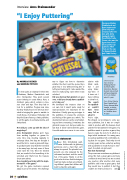
  Designers Markus Slawitscheck and Arno Steinwender (from left) were overjoyed after the win, with Anita Landgraf (right) from White Castle Games, who was the agent that found the South Korean publisher. With them are the reps for Happy Baobab and Game Factory.
  Nominiees
Grosse kleine Edelsteine by Wolfgang Warsch (Schmidt Spiele), Illustration: Mariana Zuaneti, treasure hunt with guessing game for 2 to 4 children about 5+ years
Taco Kitten Pizza by Dave Campbell and Thierry Denoual (Blue Orange), a clairvoy- ant card game for 2 to 6 children about 4+ years
 Jury statement
Magic Keys immediately capti- vates children with its glittering gemstones and a chest that can’t
always be opened. The splendid com- ponents are only surpassed by the risk-reward mechanic and the overall feel of the game. Thanks to all the good rules decisions that the designer team has made, we have an outstand- ing children’s game that children will want to play time and again.
Photos: Thomas Ecke / Spiel des Jahres e. V.


