


Page 19 - spielbox 4_24 Englisch E-Paper
P. 19
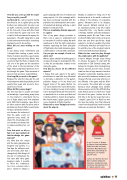
How did you come up with the topic? Are you a pilot yourself?
Luc Rémond: No, I am not a pilot, but my best friend is. He is a glider pilot; and his brother is an airline pilot, his sister is an air traffic controller, and his father pilot- ed the Concorde. It was with this friend in mind that the game was born. The cockpit is both a dream and a mystery for passengers. I thought being able to play in that environment would be something that was bound to be exciting.
When did you start working on the game?
It was during Covid confinement and I thought that creating a game on the theme of aviation would be a good excuse to exchange with my friend Olivier. And even more than the theme of aviation the real core of the game are the sensations of the pilots in the last minutes of the flight. That’s really what I wanted to recre- ate through the game. These moments of tension, trust, precision, responsibilities. How long did you work on the game? Between the very first idea and the end of development with the publisher, it took exactly three years and around a thou- sand hours of work.
Where did this journey begin?
The first step was to acquire aeronauti- cal knowledge. I spent many, many hours on the internet to understand the ba- sics of flight physics and how airplanes work. With this knowledge I was able to do video sessions with real pilots and in particular my friend’s father Jean-Claude. He was a wonderful interloc-
utor because he understood that the game could not represent every detail. He shared his knowledge with- out restraint and trusted me to make something fun out of it.
From that point on, all you had to do was translate all that knowledge into game material?
Yes. After that the cockpit and the basic gameplay was designed very quickly: in a few days the different mod- ules were fixed; after that I changed only little things. At the end of confinement, the first tests with other game designers made it possible to refine the communica- tion/non-communication part. I started to prepare a
game campaign with lots of modules and many airports. It is this campaign which has been enormously reworked with the publisher. And obviously there were sever- al hundred test landings with my co-pilot Michal to verify all of this.
This is a remarkably detailed approach to a game.
One of my game design principles is that a rule is easier to understand and to remember if it reflects reality. My work mainly was to find the right compromise between respecting the main principles of flight and a short and immersive game. I didn’t want to come up with a simulator. Can you give an example of such a re- alistic rule?
When a plane extends its landing gear, it increases its drag, it is slowing down. This is why the aerodynamic markers move during the game.
How did you choose all the different airports?
I believe that each airport in the game should have its own little story. Montreal is obviously a dedication to the game’s publisher. Prague is for my friend and biggest tester of the game: Michal. He is a Czech student who spent three years in France studying. He was at a boarding school during the week and often at home on weekends. He is a chess specialist and I introduced him to modern board games. We shared many 2-player games and of course hundreds of flights together. Please tell us more background stories about the airports.
Atlanta, in addition to being one of the busiest airports in the world, is above all a tribute to the reference of cooperative games: Pandemic—and to its designer, Matt Leacock. Keflavik reminds me of an important journey in my life: Iceland is beautiful. Oslo ... my favorite country is Norway. Sublime and wild landscapes, endearing people. Rio and Tokyo: it was my friend’s father who told me a lot about these two and their specificities. Kuala Lumpur to be able to weather the storms of Indonesia. And then obviously Toncon- tin and Paro, two of the toughest airports in the world with mountain landings. What else has come into play through the collaboration with the publisher? Scorpion Masqué brought many things to enhance the game. To start with the enthusiasm of CEO Christian Lemay, who believed in the game from the beginning. Manuel Sanchez and the entire Scorpion team has done a huge amount of work on the game’s components. Keeping a reason- able price with maximum immersion, was the goal. We had a very long reflection on the difficulty of the game and the differ- ent scenarios. This ended with no longer having a linear campaign but a sandbox where everyone can find the difficulty they want. And we put a lot of work in to clarify the rules of the game. I believe this is the first time in the last ten years that such a “complex” game (2.06 on BGG) has won the Spiel des Jahres. And that obviously comes from the publisher’s work in the two rulebooks, very airy and illustrated.
    Nominees
In the Footsteps of Darwin
by Grégory Grard and Matthieu Verdier (Sorry We Are French), Illustration: Maud Briand and David Sitbon, entertaining tile collecting for 2 to 4 players about 8+ years
Captain Flip by Paolo Mori and Remo Conzadori (Playpunk), Illustration: Jonathan Aucomte, mischievous tile placement for 2 to 5 players about 8+ years
spielbox   17


